The stack is an extremely common data structure in computer science — everything from the everyday Ctrl + Z, a browser’s back button, matching brackets, to a program’s function calls, are all applications of a stack.
Definition: Stack
A stack is a dynamic set in which the insertion and deletion of elements follows the last-in-first-out (LIFO) principle: the element removed is always the one that was most recently inserted, among those not yet removed.
A stack supports two basic operations:
push(S, x): inserts element $x$ onto the top of stack $S$pop(S): removes and returns the element at the top of stack $S$
Calling pop on an empty stack causes an underflow; an insert that would push the stack past its allocated capacity causes an overflow1. When implemented with an array, both push and pop run in $O(1)$ time.
Basic Operations
Every stack operation happens at the same end, the top: new elements go in at the top, and the only element you can take out is the one at the top — everything buried below it is out of reach. That leaves just three operations to describe the whole behaviour of a stack: push, which puts an element on top, pop, which removes the top element, and top, which peeks at the top element without disturbing it.
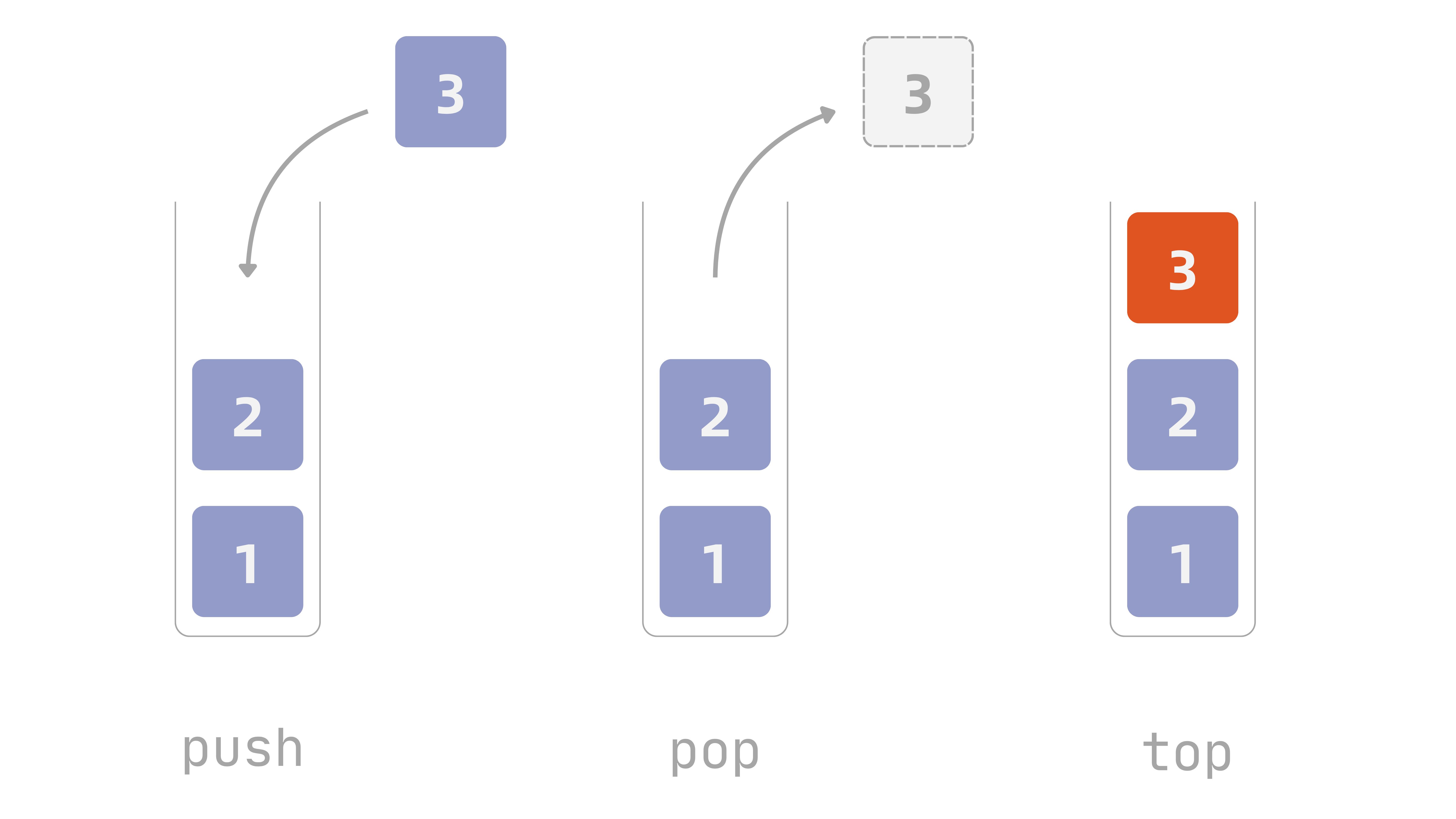
Push
Pushing first checks whether the stack is full, then does one of the following:
- If full: reject the insertion, optionally returning/printing a failure message
- If not full: add the element to the top of the stack, returning the updated stack
1 | Push(S, x) |
Pop
Popping is just a matter of checking whether the stack is empty:
- If empty: reject the pop, optionally returning/printing a failure message
- If not empty: remove the element at the top of the stack and return it
Written as pseudocode:
1 | Pop(S) |
Peek at the Top
Peeking at the top follows the same empty check first:
- If empty: reject the peek, optionally returning/printing a failure message
- If not empty: return the element at the top of the stack, without removing it
Written as pseudocode:
1 | Top(S) |
Time Complexity of Each Operation
push, pop, and top all only touch the top[S] pointer itself and whatever it points to, S[top[S]] — whether it’s a comparison, a read/write, or moving the pointer, the number of operations is fixed and never grows with however many elements are currently in the stack, so all three are $O(1)$.
| Operation | Time Complexity |
|---|---|
push |
$O(1)$ |
pop |
$O(1)$ |
top |
$O(1)$ |
| Traversal (visiting every element) | $O(n)$ |
Traversing the whole stack isn’t a standard operation, though — a stack only guarantees access to top. To visit every element, you have to start at top and walk down one by one, with no way to jump to an arbitrary position, so each element gets touched once, giving $O(n)$; traversing via pop also empties out the stack itself, unless you save each popped element elsewhere and push it back afterward.
Stack Implementation
Using an Array
1 | class ArrayStack: |
Using a Linked List
First define the node:
1 | class ListNode: |
Then implement the stack:
1 | class LinkedListStack: |
Complexity Comparison
Here’s a table comparing the time complexity of the two stack implementations:
Array Stack (ArrayStack) |
Linked List Stack (LinkedListStack) |
|
|---|---|---|
| Capacity | Limited by Python list‘s dynamic resizing mechanism |
Effectively unbounded (limited only by memory) |
| Extra space overhead | Nearly none, elements are packed tightly | Each node needs extra space for a next pointer |
| Memory locality | Good — elements are stored contiguously, high cache hit rate | Poor — nodes are scattered across memory |
push / pop / top |
All $O(1)$ | All $O(1)$ |
The time complexity of the three core operations looks identical, but the array version is usually faster in practice, because its elements sit contiguously in memory, giving better memory locality2 and a higher cache hit rate when reading and writing; each node in the linked list version is scattered across memory, so even with the same number of operations, actual access speed ends up slower. This is also why most languages’ standard libraries (like Python’s list.append/list.pop) implement their stacks with arrays — the linked list version is more useful for practicing pointer manipulation and understanding what’s happening under the hood.
Solutions
LeetCode 20: Valid Parentheses
Given a string s containing just the characters (, ), {, }, [, ], determine if the string is valid. An input string is valid if: open brackets must be closed by the same type of closing bracket, and open brackets must be closed in the correct order.
Example 1
1 | Input: s = "()" |
Example 2
1 | Input: s = "()[]{}" |
Example 3
1 | Input: s = "(]" |
Every opening bracket gets pushed onto the stack directly. When a closing bracket shows up, if the stack is empty, or the popped top isn’t the matching opening bracket, that’s a mismatch. After scanning the whole string, if the stack still has leftover opening brackets, that’s also invalid:
1 | class Solution: |
LeetCode 155: Min Stack
Design a stack that supports push, pop, top, and retrieving the minimum element in constant time. Implement the MinStack class:
MinStack()initializes the stack objectvoid push(int val)pushes the elementvalonto the stackvoid pop()removes the element on the top of the stackint top()gets the top element of the stackint getMin()retrieves the minimum element in the stack
Example
1 | Input: |
A single variable (say, min) can’t track the minimum — once an element gets popped off, there’s no way to recover what the minimum was before it was added. The fix is to maintain a second min_stack alongside the main stack, pushing and popping both in sync: every level of min_stack stores the minimum up through that level, so once the top gets popped, the level underneath already has the correct minimum recorded, with no recomputation needed:
1 | class MinStack: |
LeetCode 150: Evaluate Reverse Polish Notation
Given an array of strings tokens that represents an arithmetic expression in Reverse Polish Notation (postfix notation), evaluate the expression. The valid operators are +, -, *, /. Each operand may be an integer or another expression. Division should always truncate toward zero.
Example 1
1 | Input: tokens = ["2","1","+","3","*"] |
Example 2
1 | Input: tokens = ["4","13","5","/","+"] |
Scan through tokens from the start: push numbers as they come; when an operator shows up, pop the two most recent operands off the stack (the one popped second is the left operand a, the one popped first is the right operand b), compute the result, and push it back. After the scan, exactly one element remains on the stack — the answer.
1 | class Solution: |
One thing worth flagging: the problem requires division to truncate toward zero, which differs from Python’s //, which floors — these give different results whenever the two operands have opposite signs (for example, 7 // -2 is -4, but truncating toward zero should give -3). That’s why the division uses a / b to get a float first, then converts it with int(), to match what the problem requires.
1. This term is actually tied to what memory allocation literally looked like. On early operating systems, the stack and the heap often shared the same block of memory, but grew in opposite directions: the heap grows from low addresses toward high addresses, while the stack grows from high addresses toward low addresses, heading toward each other. If recursion goes too deep, or a local variable allocation is too large, the stack pointer keeps marching downward until it collides with the heap’s boundary — that collision is where the term overflow comes from. The well-known Q&A siteuses this term as its name, which doubles as an engineer’s inside joke: it’s both the classic error that crashes your program, and a site with a giant stack of technical Q&A piled on top of each other. ↩
2. When the CPU reads from memory, it pulls in a whole block at a time (a cache line) rather than a single value. An array’s elements sit right next to each other, so reading one is likely to bring its neighbors into the cache along with it; a linked list’s nodes are each scattered independently, so nearly every access has to go back out to main memory again — this is called a cache miss. ↩